A drinking window answers a practical question: which bottles should I consider opening now? It cannot tell you the exact evening a wine reaches perfection. The useful version is broad, editable and connected to your own notes.
Use two years, not one perfect date
Set the first year when you expect the wine to be enjoyable and the last year when you would prefer to have opened it. The space between them is the useful period. A single peak year looks authoritative but hides how much uncertainty is involved.
When information is limited, choose a wide range. A rough window that admits uncertainty is better than a narrow one copied from a bottle you have never tasted.
Start from the wine, then account for the cellar
Vintage, region, grape and style provide a starting point. Producer, winemaking and bottle format can move the range. Storage matters too. A bottle kept steadily cool and dark has had a different life from one stored for years in a warm kitchen.
Cellar can suggest a rough starting range from the type and vintage. It is deliberately editable. It does not know the producer's intent, the bottle's earlier storage or how mature you like your wine.
Read the four states as prompts
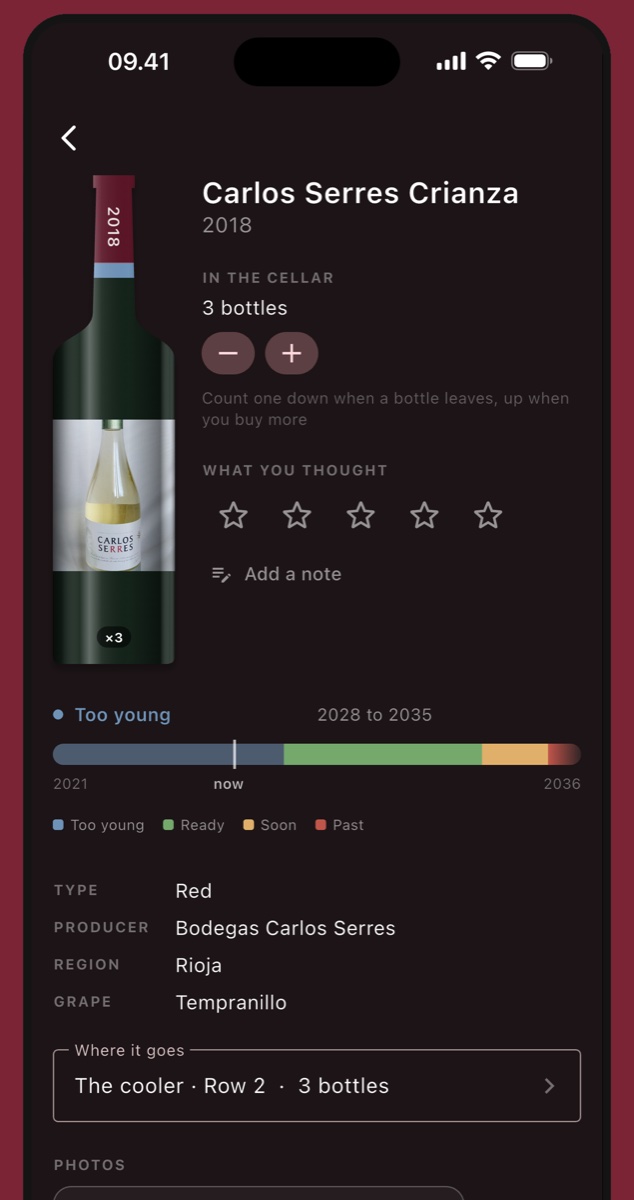
"Too young" means the window has not opened. "Ready" means the bottle is inside the chosen range. "Drink soon" marks the final part of that range. "Past" means the planned end has passed, not that the wine became bad at midnight on New Year's Eve.
Those labels help sort attention. They should not overrule the condition of the bottle or the meal you want to serve.
Open one bottle before changing the whole case
If you own several bottles, the first opening is the best information you have. Note whether it was closed, balanced, fading or still built for time. Then move the window for the remaining bottles if the evidence calls for it.
Bottle variation is real, so one disappointing cork does not prove that every bottle is over the hill. Record the condition as well as the taste.
Look at the cellar as a timeline
A list sorted only by vintage mixes wines that mature at very different speeds. A timeline shows what is moving into its ready period and what is approaching the end of the range you set. That is useful before buying more wine and before choosing what to open for a dinner.
The goal is not to predict wine perfectly. It is to notice the bottles you bought to drink before they disappear behind newer arrivals.