Inventory and memory pull in different directions. The shelf only needs to know how many bottles remain. Your future self needs to know what happened to the bottles that are gone. Keeping both requires a quantity and a separate opening history.
Count the bottle down when it leaves
The reliable moment to update stock is when the bottle is taken for opening. Waiting until the next day makes it easy to forget, especially after guests and several wines. In Cellar, Open a bottle reduces the quantity and starts a dated history entry.
If a bottle is removed for another reason, adjust the quantity without inventing a tasting note. The inventory should describe what happened, not what usually happens.
Keep the wine after the count reaches zero
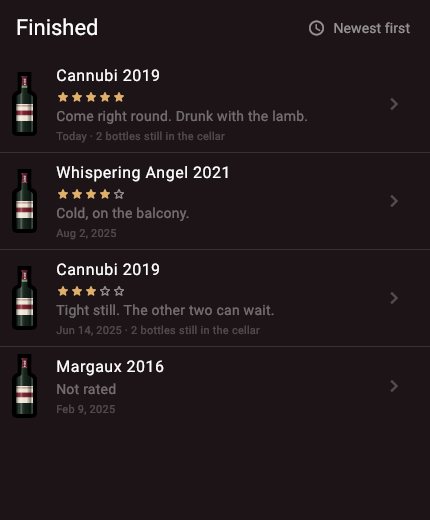
Deleting an empty wine throws away the useful part: what you thought, when you drank it and whether it deserves another purchase. Move it out of the current shelf view and into a finished history instead.
A finished list can answer a question the live cellar cannot: what did we drink last winter that worked so well with lamb?
Give every opening its own note
The first of six bottles may be tight and the last may be fully mature. Overwriting one note with another loses that development. Record each opening separately, with its own date and rating.
The wine can still show an overall rating, but the individual entries explain how it was reached.
Record the bottle, not an abstract vintage
Note cork problems, heat damage or unusual storage. A flawed bottle should not quietly become the verdict on every remaining bottle. If two people disagree, the words are more useful than forcing one definitive score.
When the bottle was sound, add the practical next step: drink another soon, give it more time or look for more.
Use the history when buying and planning
Before repurchasing, search the finished list. Before opening the next bottle, read the last note. This connects the inventory to real experience rather than turning it into a count of labels.
A collection becomes more useful as bottles leave it, provided their history does not leave with them.