Wine collections rarely live in one perfect wall of identical racks. There is a cooler, a few shelves, an unopened case and a box that was supposed to be temporary. A good location system accepts that reality and makes each place unambiguous.
Name places the way you actually refer to them
Use names that make sense without a legend. "The cooler", "Under the stairs" and "Bordeaux rack" are better than Storage A, B and C if those are the words used at home. The purpose is to find a bottle, not to make the storage sound formal.
If two places could be confused, add one useful distinction. "Kitchen cooler" and "Garage cooler" work. Long codes that must be decoded do not.
Number rows in one permanent direction
Top to bottom is easiest because it remains clear when a rack is partly empty. Do not renumber rows after removing a shelf or adding an insert. A location should be stable enough that an old note still makes sense.
Slots are worth numbering only when the rack makes them visible and stable. For most home cellars, rack and row are precise enough. The search result shows the right shelf, and the label or bottle neck does the rest.
Keep cases and boxes as real locations
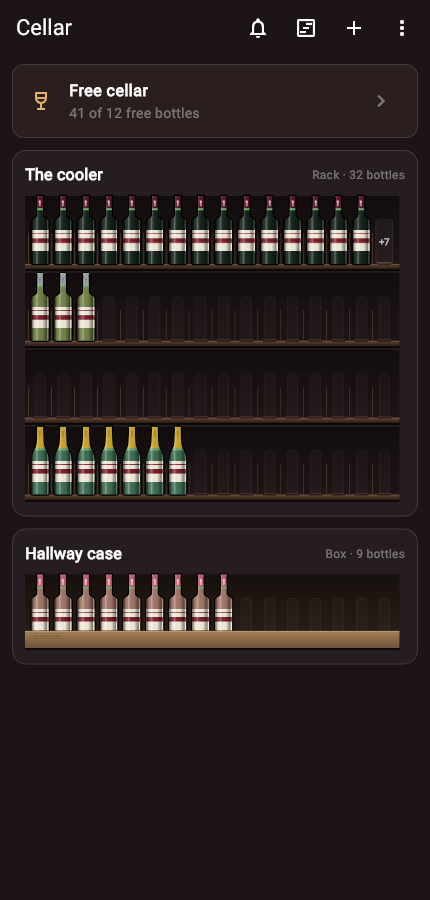
An unopened wooden case is not missing from the inventory just because its bottles are not in the main rack. Record the case as a storage place and give the wine a quantity there. The same applies to mixed cardboard boxes and short-term overflow.
When a case is opened, move only the bottles that actually leave it. If six go into the cooler and six remain in the case, the same wine should show six bottles in each location.
Do not sort the room to suit the software
Some people store by region, others by drinking date, bottle shape or whatever space was available on delivery day. All can work if the inventory records the location accurately. A digital category should not require an afternoon of moving glass unless the physical change is useful on its own.
Cellar lets one wine occupy several rows and lets racks, cases and boxes keep their own shape. The visual shelf is not decoration. It is a quick check that the digital arrangement still resembles what is in front of you.
Leave room for the collection to change
A completely full rack has no place for the next delivery. If possible, leave a few spaces in each area or keep one overflow location. This reduces reshuffling and makes new bottles easy to shelve while the purchase is still fresh in mind.
When a location is emptied for good, move its last bottles in the inventory before removing it. Stable names and small changes are what keep the system trustworthy.